Repair or Replace? A Decision Framework for Heavy Duty Industrial Exhaust Fans
Introduction
Every facility manager eventually faces a fan that is still running but clearly showing its age. Deciding whether to repair a struggling heavy duty industrial exhaust fan or replace it outright is rarely straightforward, and getting the decision wrong in either direction wastes money. Repairing a fan that should be replaced leads to repeat callouts and rising costs. Replacing a fan that only needed a bearing or motor service wastes a perfectly usable asset. This blog sets out a practical framework for making that call with confidence.
Start With the Fan’s Age and Design Life
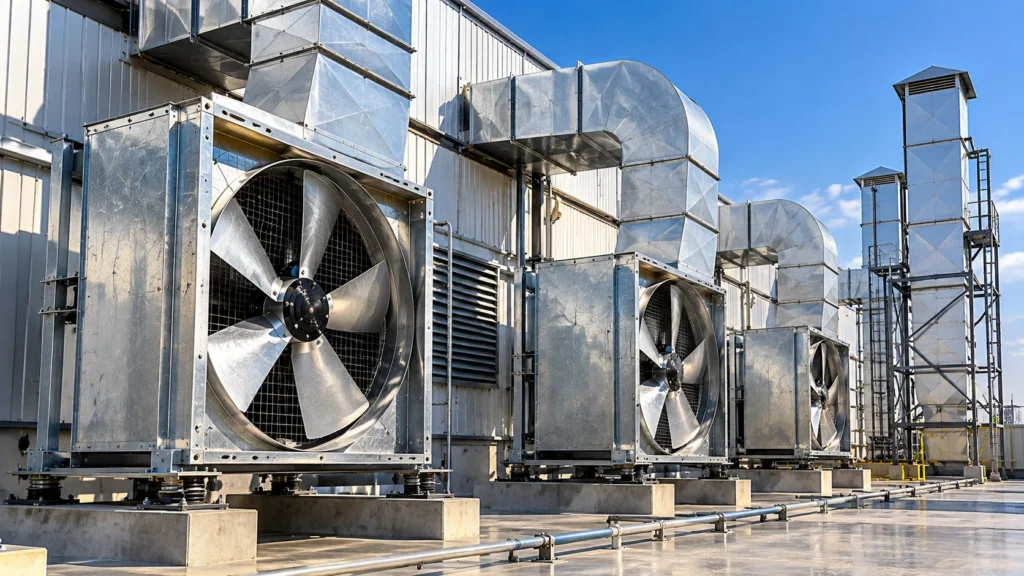
A heavy-duty industrial exhaust fan is generally designed for fifteen to twenty years of service under normal conditions. A five-year-old fan with a failed bearing is almost always worth repairing. A fan approaching or past its design life that needs a significant repair is a stronger candidate for replacement, since further failures are increasingly likely regardless of what gets fixed this time.
Compare the Repair Cost to Replacement Cost
A useful rule of thumb: if a single repair costs more than 40 to 50 percent of a new fan’s price, replacement usually makes better financial sense, particularly if the fan has already needed previous repairs. Facility managers should ask their supplier for both numbers side by side before deciding, rather than approving a repair in isolation without knowing what a replacement would actually cost.
Consider the Frequency of Recent Failures
A heavy-duty industrial exhaust fan that has needed two or three service calls in the past year is signalling that its remaining components are wearing out together, not that one part happened to fail. Repeated repairs on the same unit within a short period is one of the clearest signs that replacement will be more cost-effective than continuing to patch the same fan.
Factor In Energy Efficiency Gains
Older fans, particularly those without premium efficiency motors or variable speed capability, often consume noticeably more electricity than a current equivalent for the same airflow. When a repair decision is close, the energy savings a new heavy duty industrial exhaust fan would deliver over its remaining service life can tip the balance toward replacement, especially for fans that run continuously.
When to Repair vs When to Replace
Repair is usually the right call when:
- The fan is recent and has an isolated component failure, such as a bearing or belt
- It has a strong maintenance history and no recurring issues
- The repair cost is well below the price of a comparable replacement
- There is no urgent need for improved efficiency or added control features
Replacement is usually the safer financial choice when:
- The fan is already at or beyond its expected fifteen-to-twenty-year design life
- It has had two or more unrelated failures within the past twelve months
- The repair quote is close to half the cost of a new equivalent fan
- The facility has grown or changed use since the original fan was installed, making its original capacity a poor match today
Get a Second Opinion and Keep a Record
For any repair quote approaching the cost threshold above, it is worth asking a second, independent technician to inspect the fan before committing either way. A supplier who is also selling the replacement option has an obvious incentive to recommend it, so an independent assessment — or at minimum a clear, itemised breakdown of exactly what the repair involves — protects against paying for a repair that was never going to solve the problem, or discarding a fan that had years of life left. Whichever way the decision goes, recording the reasoning behind it — the fan’s age, the repair quote, and who was consulted — creates a useful reference the next time a similar decision comes up, and over several years can reveal which fan models or installation conditions consistently lead to early replacement.
Related blog post – How to Choose a Heavy-Duty Industrial Exhaust Fan for Your Facility
Presto: Supporting the Repair or Replace Decision
Presto assesses each heavy-duty industrial exhaust fan on its own condition and history, providing straightforward repair and replacement pricing so facility managers can compare both options honestly before committing either way.
Conclusion
Deciding whether to repair or replace a heavy-duty industrial exhaust fan comes down to age, repair cost relative to replacement price, failure frequency, and potential efficiency gains, weighed together rather than in isolation. Facility managers who apply this framework consistently avoid both premature replacement and the rising cost of repeatedly patching a fan that is past its useful life. Presto continues to help UAE facilities make this call with clear, honest guidance rather than a one-size-fits-all recommendation.