
FRP vs Steel Exhaust Fans: A Cost and Performance Comparison for UAE Facilities
Introduction
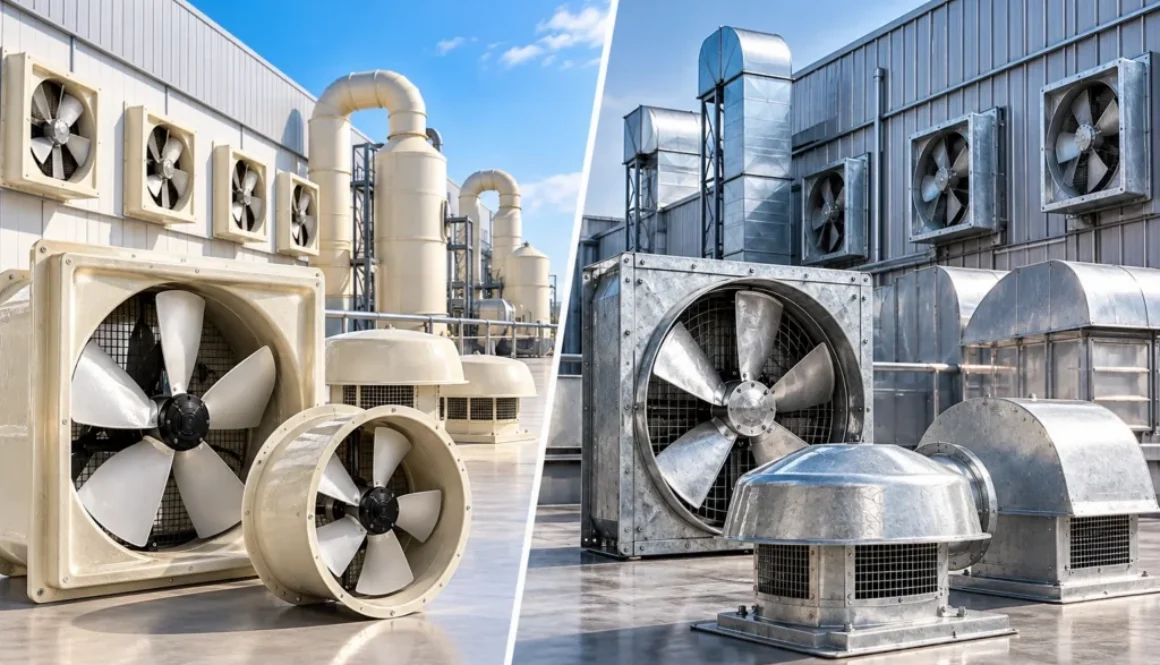
Facility managers replacing or specifying industrial ventilation equipment eventually face the same decision: a standard steel exhaust fan, or a FRP fiberglass exhaust fan. Steel is familiar and usually cheaper on the quotation. FRP costs more upfront but is marketed as the longer-lasting option. Choosing between them without real numbers means guessing at long-term value instead of calculating it. This comparison looks at FRP and steel exhaust fans across the factors that actually affect a UAE facility’s budget over time: purchase price, corrosion resistance, maintenance costs, expected service life, and total cost of ownership, so the decision can be made on evidence rather than habit.
Purchase Price: Steel Usually Wins on Day One
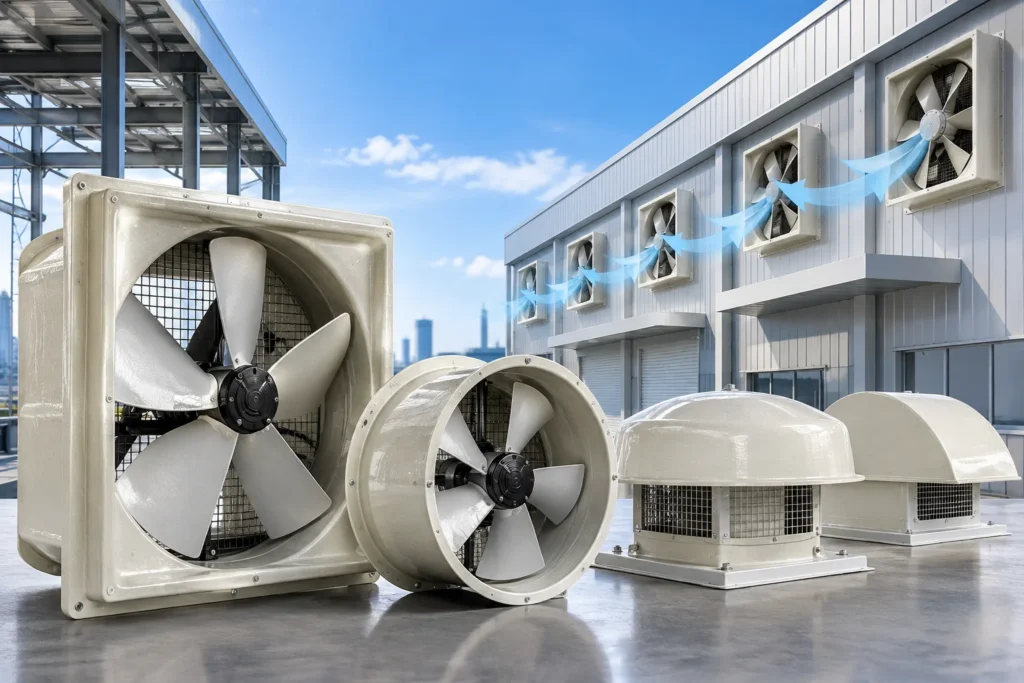
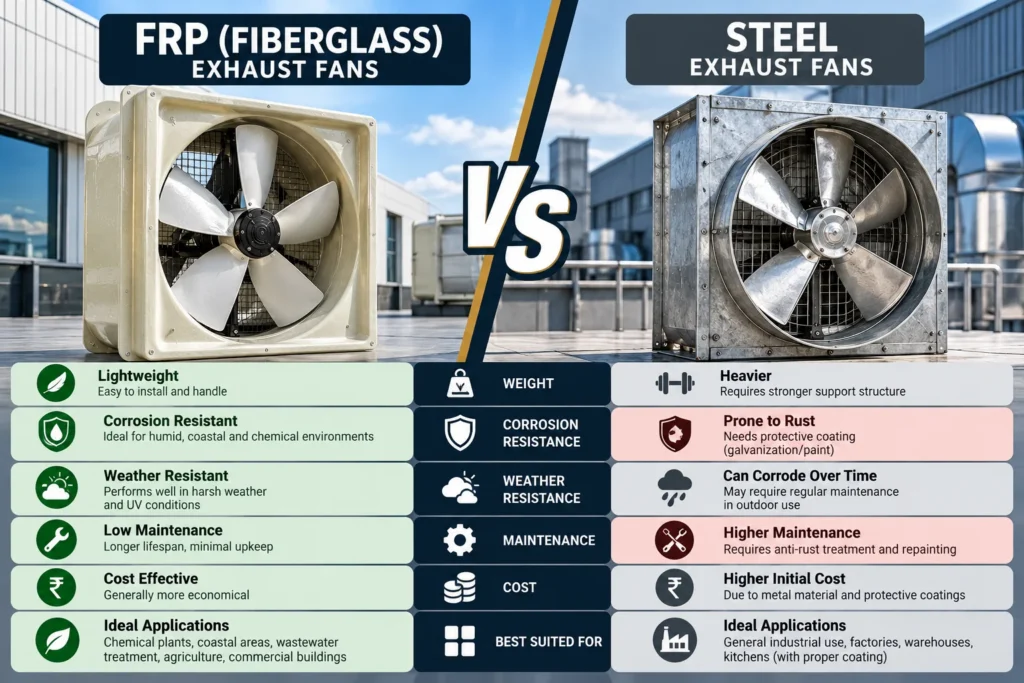
A steel exhaust fan is typically less expensive to buy than an equivalent FRP fiberglass exhaust fan of the same size and airflow rating. For dry, non-corrosive environments such as general warehouses and workshops, this upfront saving is a legitimate reason to choose steel, since the fan will not face the chemical or moisture exposure that erodes protective coatings over time. Buyers evaluating price alone, without considering the operating environment, are the ones most likely to make the wrong choice.
Corrosion Resistance Changes the Calculation Completely
In facilities that exhaust chemical fumes, high humidity, or salt-laden coastal air, the picture reverses. A steel fan’s corrosion protection depends entirely on a coating that eventually gets scratched, welded through, or chemically attacked, after which rust spreads underneath the surface where it cannot be seen or easily repaired. A FRP fiberglass exhaust fan has no metal surface to corrode in the first place, so its resistance does not depend on maintaining an intact coating. In these environments, steel’s lower purchase price is offset by a much shorter working life.
Maintenance and Repair Costs Over Time
Steel fans operating in corrosive conditions typically need recoating, patch repairs, or early bearing replacement as corrosion spreads into moving parts. Each of these repairs adds labour and downtime cost that rarely appears in the original purchase decision. A FRP fiberglass exhaust fan in the same environment generally needs only routine bearing and motor servicing, the same as it would in a mild environment, because the housing and impeller are not degrading in the background.
Expected Service Life
Industry experience across the UAE generally shows steel fans in corrosive applications lasting a fraction of their rated design life, sometimes requiring replacement within five to eight years. A properly specified FRP fiberglass exhaust fan in the same conditions commonly runs for fifteen years or more with routine maintenance, simply because the material itself is not the weak point.
Calculating Total Cost of Ownership
The only fair comparison adds purchase price, installation, expected maintenance spend, and replacement frequency together over a fixed period, such as fifteen years. For a corrosive or humid application, this calculation almost always favours the FRP fiberglass exhaust fan despite its higher starting price, because it avoids the repeat replacement cycle that a steel fan goes through in the same conditions. For dry, non-corrosive settings, steel frequently remains the more economical option across the same period.
When Steel Still Makes Sense
Not every application needs FRP. General warehouses, workshops, and other dry indoor spaces without chemical exposure rarely justify the added cost of a FRP fiberglass exhaust fan, and steel construction performs reliably in these conditions for many years. Matching the material to the actual environment, rather than defaulting to either option, is what separates a good specification decision from a costly one.
Related blog post – Why FRP Exhaust Fans Are Perfect for UAE Industrial Facilities
Presto: Helping UAE Facilities Choose the Right Fan Material
Presto supplies both steel and FRP fiberglass exhaust fan options and helps customers calculate the real cost comparison for their specific application before recommending either. Their technical team looks at the operating environment first, rather than starting from a price point, so the recommendation reflects what the facility actually needs over its full-service life.
Conclusion
Choosing between steel and a FRP fiberglass exhaust fan is not simply a matter of which costs less to buy. Purchase price, corrosion exposure, maintenance frequency, and expected service life all need to be weighed together to find the option that costs less over time. Facilities operating in corrosive or humid conditions typically find that FRP earns back its higher price many times over, while dry environments often do fine with steel. Presto continues to help UAE businesses make this comparison based on their actual operating conditions rather than guesswork.